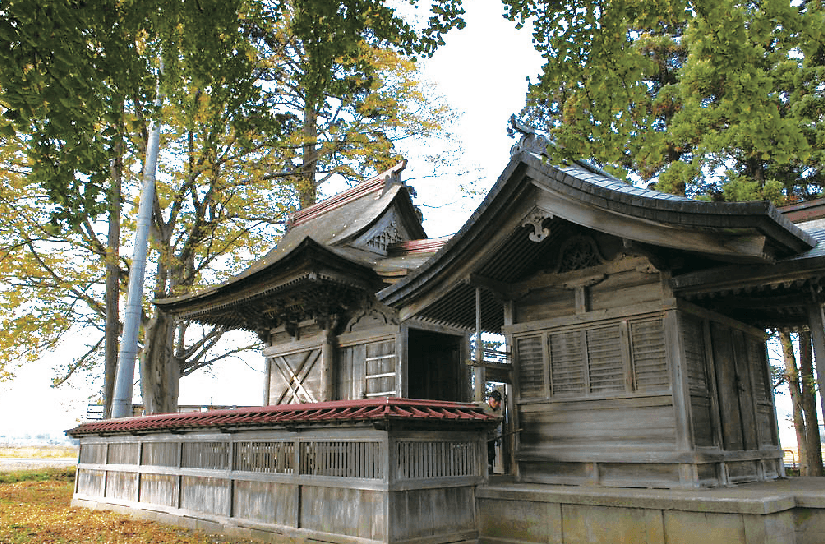
The Honden (main sanctuary) of Koshiō Shrine, a National Important Cultural Property, is said to have been built in the first year of the Genki era (1570) at the end of the Muromachi period by Togashi Saemon-Taro Katsuie, lord of Kujaku Castle, and crafted by the famed Hida master artisan “Jinbee.”
The honden is built in the one-bay shrine irimoya style, an eclectic design that freely blends Japanese, Zen Buddhist (Kara-style), and Great Buddha style (Tenjikuyō) elements. Its bold construction, with unusual motifs found throughout, is a defining feature. The chrysanthemum-vine arabesque on the mizuhiki rainbow beam at the front of the porch, and the wisteria-vine arabesque pattern on the side hanetsabaki brackets, are masterpieces rarely seen. In addition, the tasuki-zaiku latticework, which symbolizes a “boundary,” applied on all sides including the karahafu doors, as well as the large kappa-mata bracket ornaments and gibōshi finials, are unlike anything else.
Although the building is adorned with elegant carvings down to the smallest details, its greatest feature is said to be its architectural style, which combines delicacy with power, including a sturdy foundation made of rough-hewn thick timbers.
Tokyo Imperial University professor Chūta Itō (1867–1954), an authority on art and architecture at the time, praised it as “the rarest of the rare, the most extraordinary of the extraordinary.” Later, architectural historian and Kyoto Imperial University professor Shunichi Amanuma (1876–1947) also declared it “a peerless structure beyond Japanese, Chinese, and Indian styles.”
Please take your time to appreciate the bracket complexes, the many graceful carvings throughout, and the beauty of the deep overhanging eaves and sweeping curves.
Koshiō Shrine enshrines Ōhiko no Mikoto as its deity. According to legend, Emperor Sujin dispatched the Four Regional Generals across Japan, and Ōhiko no Mikoto, who traveled to Koshi no Kuni (the Hokuriku region), rested on a large stone here. The villagers revered him and built a shrine in his honor. Koshiō shrines are often found along the Sea of Japan coast from central Japan northward, and many of their shrine buildings face north (shrine buildings are usually oriented south).
Long associated with daily life in the local community as a Ubusuna-sama (guardian deity of the native land), it has long been the focus of many prayers and wishes. In recent years, it is especially believed to bring good fortune in contests and competition.
Why not visit and pray for success in sports, tournaments, starting a business, a promotion, or any of life’s important competitions?
【Closed】No closing days (free to stroll the grounds)
【Guide】The site is open for self-guided visits, but for guided group tours, please contact the Cultural Properties Section.
【Other】We can assist with goshuin stamps and related matters, so please contact the Cultural Properties Section.
【Parking】5 spaces